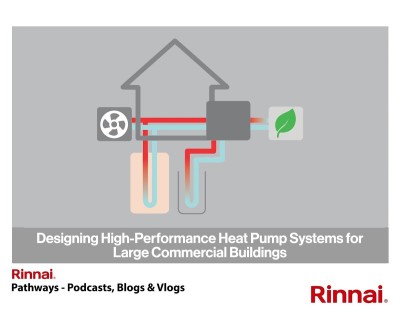
Large commercial buildings are among the highest energy consumers which traditionally have relied on fossil fuel based HVAC systems that contribute significantly carbon emissions. This shows decarbonising and transitioning these properties to low carbon systems such as heat pumps has become an urgent priority for reducing carbon impact.
Why Heat Pumps Are Critical for Large Commercial Buildings
Heat pumps transfer heat from ambient sources such as air, ground or water. Which allows them to deliver three or more units of heat for every unit of electricity consumed, making them significantly more efficient than gas or oil systems.
This increase in efficiency means lower operational costs and huge reductions in carbon emissions for large commercial buildings that have high heating, cooling and domestic hot water demands. Heat pumps are a future-proof solution as electricity grids continue to decarbonise, the environmental benefits will increase.
Understanding the Unique Challenges of Large Commercial Buildings
Designing heat pump systems for large commercial buildings comes with challenges that differ to smaller buildings.
High and Variable Loads
Commercial buildings such as offices, hospitals, hotels and retail buildings usually require heating and cooling simultaneously in different areas. The hot water demands and occupancy patterns creates complex and diverse heating, cooling and hot water requirements. Accurate load modelling is essential to ensure the system can meet peak demand efficiently without excessive oversizing.
Retrofitting Existing Infrastructure
Most large commercial projects involve existing buildings. Careful analysis should be completed when integrating heat pumps with existing pipework, emitters and control systems. Older systems may have been designed for high flow temperatures, while heat pumps perform best with low-temperature distribution. Necessary upgrades such as emitter replacements or pipework modifications should be identified early for project success.
Space, Noise, and Vibration Constraints
Careful consideration should be made when plant space is limited so outdoor units or plant rooms may be the better option. This is also the case when noise constraints need to be adhered to, to protect occupants and neighbouring properties.
Operational Resilience
Heat pump systems need to be designed with redundancy, modularity and intelligent fault detection to keep up with the high demands of commercial buildings. Heating and cooling failures can disrupt operations, cause financial problems and damage reputations so a reliable performance is critical.
Phase 1: Assessment and Feasibility
High-performance outcomes depend on a rigorous early-stage assessment.
Load Analysis and Energy Audits
A detailed analysis of heating, cooling, and domestic hot water loads forms the foundation of the design. This includes reviewing historical energy data, occupancy patterns, internal gains, and building fabric performance. An energy audit can also identify opportunities to reduce demand through insulation upgrades or fabric improvements, enabling smaller and more efficient heat pump systems.
Site and Heat Source Evaluation
The suitability of air, ground, or water heat sources must be assessed. For air source systems, available external space, airflow, and local temperature profiles are key considerations. Ground source systems require geological assessment, sufficient land or borehole access, and higher upfront investment but offer stable year-round performance.
Existing Distribution Systems
Understanding the capacity and condition of existing pipework, ductwork, and terminal units is essential, particularly for retrofit projects. This determines whether the system can operate effectively at lower temperatures or if upgrades are required.
Financial Feasibility
Early financial modelling helps align technical ambition with commercial reality. This should consider capital costs, operational savings, maintenance requirements, and potential incentives. Clear lifecycle cost analysis is often essential for stakeholder approval.
Phase 2: Strategic System Design and Technology Selection
Selecting the Right Heat Pump Technology
Air source heat pumps are generally easier and cheaper to install, making them suitable for many commercial applications. Ground source systems offer higher and more stable efficiencies but require greater space and capital investment. Hybrid approaches may be appropriate where constraints exist or phased decarbonisation is required.
Emerging technologies, including high-temperature heat pumps and systems using natural refrigerants such as CO₂, are particularly valuable for older buildings and high domestic hot water demands.
Accurate System Sizing
Correct sizing is critical. Undersized systems risk comfort issues and excessive backup use, while oversized systems suffer from inefficiency, cycling losses, and unnecessary capital cost. Design should account for peak loads, part-load operation, and potential future changes in building use.
Refrigerant Selection
Refrigerant choice has a major impact on environmental performance. With increasing regulatory pressure on high-GWP refrigerants, low-GWP and natural refrigerants are becoming standard for commercial applications. This supports long-term compliance and reduces the indirect carbon footprint of the system.
Supporting Components
High-performance systems depend on more than the heat pump itself. Efficient compressors, heat exchangers, pumps, and valves all contribute to system reliability and efficiency. Modular designs with multiple units can improve resilience and allow better load matching.
Phase 3: Distribution, Controls, and Integration
Efficient Heat Distribution
Distribution systems should be designed to minimise heat losses and pressure drops. Low-temperature emitters such as fan coil units or underfloor heating improve heat pump efficiency. Zoning allows precise control and avoids over-conditioning unoccupied areas.
Smart Controls and Building Management Systems
Advanced controls are essential at commercial scale. Integration with a Building Management System enables weather compensation, demand forecasting, optimal unit sequencing, and response to energy tariffs. Smart controls unlock much of the efficiency potential of heat pump systems.
Integration with Renewable Energy
Heat pumps perform best as part of a wider electrification strategy. Integration with on-site solar PV and battery storage can reduce grid reliance, lower operating costs, and further reduce emissions. This systems-based approach significantly enhances long-term sustainability.
Phase 4: Installation, Commissioning, and Performance Assurance
Even the best-designed system can underperform if poorly installed or commissioned.
Professional Installation
Commercial heat pump installations require specialist expertise, particularly for refrigerant handling, electrical integration, and large-scale pipework. Attention to detail during installation directly affects efficiency, noise performance, and system lifespan.
Commissioning and Testing
Thorough commissioning ensures the system operates as designed. This includes testing control sequences, balancing flows, verifying outputs, and confirming performance under different operating conditions. Commissioning is critical to avoiding long-term inefficiencies.
Monitoring and Maintenance
Ongoing monitoring through the BMS enables performance tracking, early fault detection, and predictive maintenance. Regular servicing maintains efficiency, protects equipment, and ensures the system continues to meet carbon and energy targets.
The Strategic Benefits
High-performance heat pump systems deliver more than operational improvements. They significantly reduce carbon emissions, lower energy costs, and help organisations meet regulatory and ESG commitments. They also enhance asset value, future-proof buildings against tightening carbon regulations, and demonstrate visible leadership in sustainability.
Conclusion
Designing high-performance heat pump systems for large commercial buildings requires a structured, whole-system approach. From early feasibility and load analysis through to detailed design, intelligent controls, and ongoing performance management, every stage influences long-term success.
When correctly designed and implemented, heat pumps offer a clear pathway to decarbonisation, operational efficiency, and resilience. Partnering with experienced building services designers and adopting a holistic electrification strategy is essential to unlocking their full potential and delivering a sustainable, high-performance future for commercial buildings.
Contact us today to size your next commercial heat pump project.
Have a look at our R290 Heat Pump range here on our website:
R290 Commercial and Industrial Heat Pumps 40kW-410kW
Low GWP R290 Air Source Heat Pump 6kW-18kW
Or download our brochures here: