Consistent and reliable hot water is a necessity in commercial sites, from hotels and hospitals to universities, leisure centres and industrial facilities. However, the energy consumption, operational costs and carbon emissions of traditional water heating systems are becoming a major issue. As energy prices continue to fluctuate and decarbonisation targets become more demanding, commercial sites face growing pressure to find more efficient and sustainable solutions.
This is particularly important for high demand commercial sites, where large volumes of hot water are required and peak demand can be unpredictable. Hybrid hot water systems are emerging as one of the most effective and practical energy saving solutions.
The challenge of hot water in high-demand commercial buildings
High-demand commercial sites such as hotels, healthcare facilities, care homes, restaurants and industrial operations place a lot of strain on water heating systems. These buildings require quick, consistent and reliable hot water, often across multiple usage points. Traditional single-technology systems, typically gas or oil boilers, can struggle to maintain efficiency under these conditions and often operate continuously at high load, leading to excessive energy use and carbon emissions.
At the same time, many organisations are under increasing pressure to meet environmental, social and governance (ESG) targets and commit to Net Zero pathways. Heating and hot water remain one of the largest contributors to energy consumption in buildings, making them a priority area for carbon reduction strategies. For many sites, fully electrifying water heating is not yet feasible due to infrastructure limitations, electrical capacity constraints or cost considerations. This is where hybrid systems provide a practical alternative.
What is a hybrid hot water system?
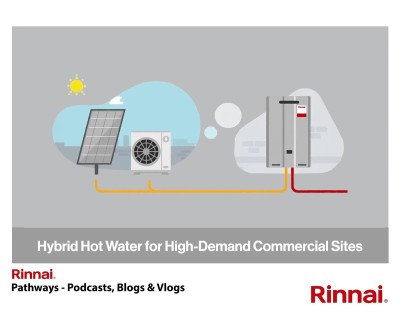
A commercial hybrid hot water system most commonly involves pairing a high-efficiency heat pump with a conventional boiler or continuous flow water heater. Each component plays a distinct role, with the system switching between them to maximise efficiency and performance.
Heat pumps use renewable energy from the air to generate hot water with very high efficiency, often producing three to four units of heat for every unit of electricity consumed. They are ideally suited to handling base load demand, where hot water is required steadily over long periods. However, heat pumps alone may struggle to respond quickly to sudden spikes in demand or extreme temperature conditions.
The secondary heat source – typically a gas boiler or continuous flow water heater – provides rapid response and peak load support. This ensures the system can always meet high or unexpected demand without compromising reliability or user comfort. Advanced control systems coordinate the operation of both technologies, selecting the most efficient and cost-effective option at any given time.
Why hybrid systems deliver superior energy savings
Hybrid systems use demand levels, ambient temperature and energy tariffs to optimise performance, rather than relying on a continuously operating single heat source.
During normal operation, the heat pump supplies most of the hot water using low-carbon, renewable energy. This significantly reduces energy consumption compared to traditional boiler-only systems. When demand increases or external conditions become less favourable, the system automatically engages the secondary heat source to maintain output without placing excessive load on the heat pump.
This intelligent fuel switching ensures that each technology is used only when it performs best. As a result, overall system efficiency is maximised, energy waste is minimised, and operating costs are significantly reduced.
Reducing carbon emissions and supporting Net Zero
Hybrid hot water systems play a crucial role in decarbonising commercial buildings. By prioritising heat pump operation, they dramatically reduce reliance on fossil fuels and lower overall carbon emissions. This makes them a powerful tool for organisations seeking to align with Net Zero targets and sustainability commitments.
Importantly, hybrid systems also provide a future-proof pathway to full decarbonisation. As electrical infrastructure improves and grid electricity becomes increasingly low carbon, the heat pump component can gradually take on a greater proportion of the load. In the long term, secondary heat sources can be replaced with low-carbon alternatives such as hydrogen-ready or fully electric technologies.
This phased approach allows building owners to reduce emissions immediately without requiring costly or disruptive infrastructure upgrades in the short term.
Managing electrical capacity challenges
One of the major barriers to electrification in high-demand commercial buildings is electrical capacity. Large-scale electric water heating systems can place significant strain on existing power supplies, often requiring expensive network upgrades or incurring high demand charges.
Hybrid systems overcome this issue by balancing electrical and gas-based heating. The heat pump operates efficiently during normal conditions, while the secondary heat source manages peak loads. This reduces peak electrical demand and allows buildings to benefit from electrification without overwhelming their electrical infrastructure.
For many commercial sites, this makes hybrid systems the most realistic and financially viable route to low-carbon water heating.
Reliability and operational resilience
In high-demand environments, reliability is just as important as efficiency. Any interruption to hot water supply can have serious consequences, affecting guest experience, patient care, hygiene standards and operational continuity.
Hybrid systems provide built-in redundancy. If one component requires maintenance or experiences reduced performance, the other can continue supplying hot water. This ensures uninterrupted service and significantly reduces the risk of downtime.
For sectors such as healthcare, hospitality and care homes, this level of resilience is a critical advantage.
The role of advanced control systems
The intelligence of a hybrid system lies in its control technology. Modern systems use sophisticated control algorithms to monitor usage patterns, system performance, weather conditions and energy costs. This data is used to continuously optimise operation in real time.
Control systems also ensure compliance with health and safety requirements, such as maintaining safe hot water temperatures to prevent Legionella risk. Many systems include scheduled temperature boosting cycles to ensure hygienic operation without sacrificing efficiency.
In addition, remote monitoring and digital services allow facilities teams to track performance, identify faults early and optimise maintenance schedules. This proactive approach improves system reliability and extends equipment lifespan.
Sector-specific benefits
Hybrid hot water systems offer clear advantages across a wide range of commercial sectors:
Hospitality: Hotels and leisure facilities benefit from consistent hot water for guest rooms, kitchens and spas, while significantly reducing energy costs and carbon footprint.
Healthcare and care homes: Hybrid systems provide reliable high-temperature water for hygiene and infection control, combined with energy-efficient operation.
Education and public sector: Schools and universities experience variable demand profiles, making hybrid systems ideal for managing fluctuating loads efficiently.
Industrial and manufacturing: Hybrid systems can be engineered for large process demands, offering robust performance with lower operational costs.
Installation and retrofit advantages
One of the most attractive features of hybrid systems is their compatibility with existing infrastructure. In many cases, they can be integrated into existing pipework and plant rooms with minimal disruption. This makes them particularly suitable for retrofit projects, where full system replacement may be impractical. Hybrid system can also support the practicalities of retrofitting as they reduce the requirement for on-site storage, electrical demand, heat pump installation and space.
Conclusion
Hybrid hot water systems represent one of the most effective and practical energy-saving solutions for high-demand commercial sites. By intelligently combining heat pump technology with a secondary heat source, they deliver outstanding efficiency, significant carbon reduction and reliable performance that traditional systems cannot match.
They provide a realistic pathway to decarbonisation, overcoming electrical capacity limitations while supporting Net Zero goals. At the same time, they ensure uninterrupted hot water supply, operational resilience and long-term cost savings.
For commercial buildings facing rising energy costs, sustainability pressures and increasing demand, hybrid hot water is not just an upgrade – it is a strategic investment in future-proof, low-carbon infrastructure